How to read a CoA: understanding a peptide lab certificate
For grey-market peptides, a CoA is often the only document that says anything at all about the contents. A certificate stating "99% purity" sounds reassuring. But it can be genuine and still meaningless for your vial, or simply forged. In this guide we go through an example certificate line by line and show how to tell a usable certificate from a worthless one. We do not recommend any lab or vendor.
What is a CoA?
CoA stands for Certificate of Analysis. It is a test report: it records which sample was tested with which method and what the result was. For authorised medicinal products, this is part of a tightly regulated system: the tests are defined in the marketing authorisation, the methods are validated, and each batch is released under GMP rules. For synthetic peptides, the EMA has a dedicated guideline, which has applied since June 2026.
The grey market lacks this system. There, a CoA is a single document with no authorisation behind it. What it tells you depends solely on who produced it, what exactly was measured and whether the sample really came from your batch.
Who issues a CoA?
A certificate issued by the vendor or its manufacturer itself is a self-declaration. An independent testing lab, by contrast, has no interest of its own in the result. Accreditation under DIN EN ISO/IEC 17025 shows whether a lab works to the requirements for testing laboratories. In Germany it is granted by the German Accreditation Body (Deutsche Akkreditierungsstelle, DAkkS), which keeps its accredited bodies in a public database. Important: an accreditation applies to specific procedures, not automatically to every analysis a lab performs.
Many test reports can be verified online with the issuing lab, using an order number and a verification code. How exactly this works is shown by our tool for checking certificates.
What is in a CoA?
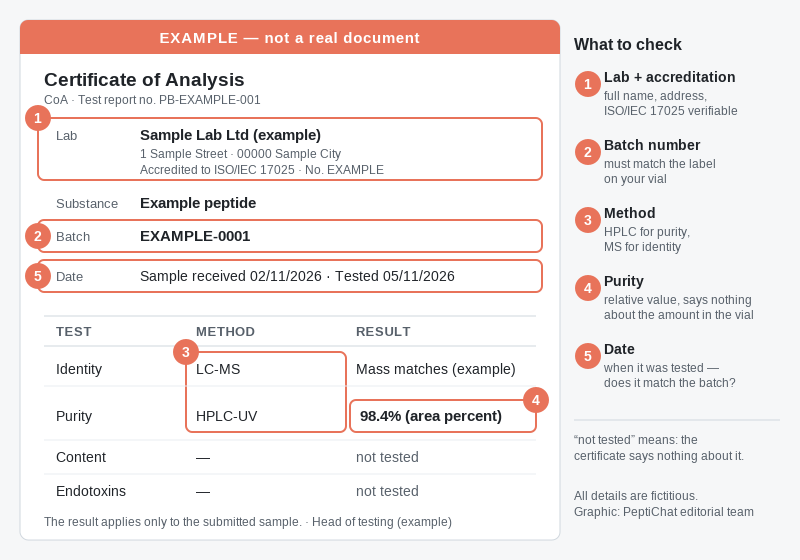
A usable certificate answers five questions. The numbers correspond to the markers in the example above:
- 1. Lab and accreditation: the lab's full name and address, plus an accreditation you can look up yourself. If both are missing, the report cannot be verified.
- 2. Batch number: it must match the label on your vial. Without a batch reference, the result applies to some sample, not to yours.
- 3. Method: how was it measured? For purity this is usually high-performance liquid chromatography (HPLC), for identity mass spectrometry (MS), often coupled as LC-MS. Numbers without a method cannot be followed up.
- 4. Purity: the percentage everyone looks at. What it means and what it does not is explained in the next section.
- 5. Date: when the sample was received and when it was tested. A report without a date cannot be placed in time against any batch.
What does the purity figure mean?
The purity on a CoA almost always comes from HPLC. It states what share the main peak makes up of all peaks detected in the chromatogram. This is a relative value. It does not tell you how many milligrams of peptide are in the vial, and without an identity confirmation by mass spectrometry it does not reliably tell you whether the main peak is even the right peptide.
A lyophilisate also never consists of peptide alone. Synthetic peptides are usually present as a salt, often with trifluoroacetate (TFA) or acetate as the counter-ion, plus residual water. How much is actually in there is only answered by a content figure in milligrams per vial.
How far apart these can be is shown by a study in the Journal of Medical Internet Research (2024): researchers tried to obtain semaglutide online without a prescription. Of six attempts, only three vials arrived at all. In these, the purity measured by LC-MS was only 7.7 to 14.4%, although 99% had been advertised. At the same time, the measured semaglutide content was 29 to 39% above the printed amount. Purity and quantity are therefore two different questions.
What HPLC measures exactly, how it differs from mass spectrometry and whether 98% is enough are explained in detail in our guide to HPLC purity in peptides.
How can I recognise a forged CoA?
Forged or misused certificates are common on the grey market. The most frequent patterns:
- Copied genuine certificate: the report exists but belongs to a different client, a different substance or a different batch.
- No batch number, or one that does not match the label on your vial.
- Lab that cannot be verified: no full name, no address, no option for online verification.
- No method stated: only numbers, with no mention of HPLC, MS or test conditions, and no chromatogram or spectrum.
- Conspicuously round or always identical values across many batches.
- Verification link from the vendor: always check directly on the lab's own website, not via a link sent to you.
What does a CoA NOT tell you?
A CoA only applies to the sample tested. Even a genuine, independent certificate says nothing about other batches, and strictly speaking nothing reliable about other vials from the same batch if production is not controlled. It says nothing about how the goods were stored and transported afterwards.
A CoA also does not replace pharmaceutical manufacturing: grey-market peptides are not produced and tested to medicinal-product standards, even if the certificate looks good. A verifiable, independent report with a batch reference is considerably more than nothing. It is a snapshot, not a guarantee.
Many certificates also test only purity and identity. For a product that enters the body, other points are just as important, and they appear only if they were tested specifically:
- Endotoxins: components of the cell wall of certain bacteria that can trigger fever and inflammatory reactions. They are measured with the LAL test according to USP <85> or Ph. Eur. 2.6.14. Sterile does not mean endotoxin-free: in the JMIR study all three samples were free of live microorganisms but still contained endotoxins.
- Heavy metals (elemental impurities): for medicinal products, the ICH Q3D guideline regulates which elements are permitted up to which amount.
- Sterility: the sterility test according to Ph. Eur. 2.6.1 or USP <71> examines a sample. A negative result only means that nothing grew in the sample tested.
Frequently asked questions
What is a CoA for peptides?
A Certificate of Analysis. It is a test report that records which lab tested which sample with which method and with what result. It applies only to the sample tested.
What should I look for when reading a CoA?
Five points: a verifiable lab with accreditation, a batch number that matches your vial, a stated method, the purity and the test date. If one of them is missing, the certificate can hardly be verified.
How do I recognise a forged lab certificate?
Typical signs are missing or mismatching batch numbers, labs without a verifiable identity, missing method details and genuine reports that belong to a different client or a different substance. Always verify the report yourself directly with the lab and compare substance, amount and batch with your vial.
Does the purity on the CoA tell me how much peptide is in the vial?
No. The purity from HPLC is a relative value: the share of the main peak among all detected peaks. How many milligrams are in there is only answered by a separate content figure.
Is a peptide with a CoA safe?
No, not automatically. A CoA is a snapshot of one sample. Endotoxins, sterility and content are often not tested at all, and the goods are not manufactured to medicinal-product standards. A good CoA lowers the risk; it does not rule it out.
Sources
- EMA — Guideline on the development and manufacture of synthetic peptides (EMA/CHMP/CVMP/QWP/367182/2025), applicable from 01/06/2026.
- D'Hondt M et al. — Related impurities in peptide medicines. J Pharm Biomed Anal 2014;101:2–30.
- Ashraf AR et al. — Multifactor Quality and Safety Analysis of Semaglutide Products Sold by Online Sellers Without a Prescription. J Med Internet Res 2024 (PMC11582493).
- Citropin 1.1 — Trifluoroacetate to Chloride Counter-Ion Exchange (PMC5918489): TFA as counter-ion of synthetic peptides.
- FDA — Guidance for Industry: Pyrogen and Endotoxins Testing: Questions and Answers (USP <85>, LAL test).
- EMA — ICH Q3D Elemental impurities (R2).
- USP <71> Sterility Tests (harmonised with Ph. Eur. 2.6.1): limits of sterility testing.
- ICH Q4B Annex 8(R1) — Sterility Test General Chapter: Ph. Eur. 2.6.1, JP 4.06 and USP <71> are regarded as interchangeable.
- DAkkS — Testing and calibration laboratories according to DIN EN ISO/IEC 17025, database of accredited bodies.